Material
Cotton
A hard wearing natural fibre that takes water and most household cleaners, and whose main enemy is drying heat applied before the stain has gone.
- SurfacePorous
- WashingMachine
- Colour run riskMedium
- Reviewed31 August 2026
What cotton can and cannot take
- Heat Use with care
- Water and soaking Tolerates it
- Acids, including vinegar Tolerates it
- Strong alkalis Tolerates it
- Solvents Use with care
- Chlorine bleach Use with care
- Abrasives Use with care
Always test on a hidden area first and let it dry before you treat the visible mark.
General rules for cotton
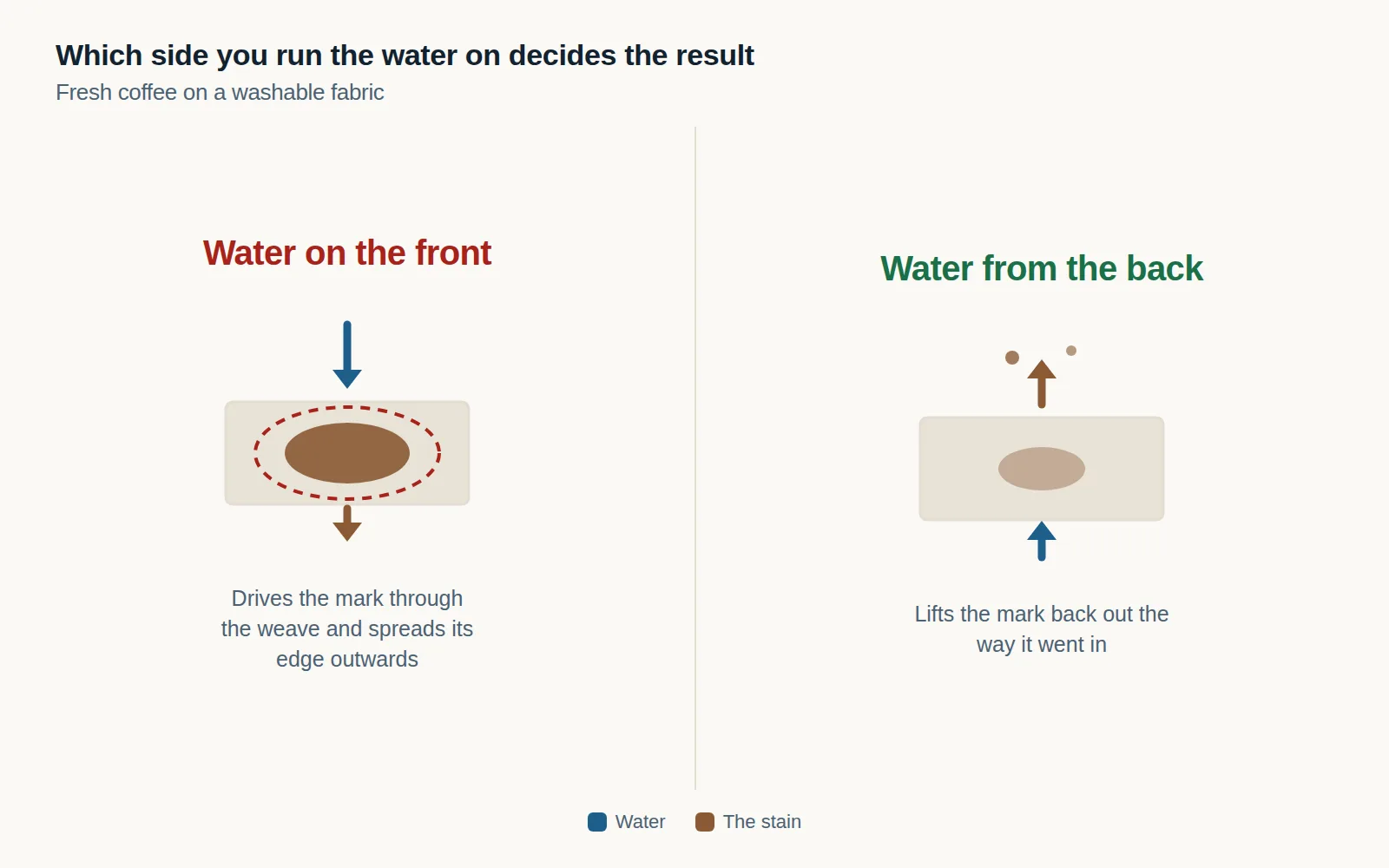
Cotton takes water freely, so flushing from the back of the fabric is almost always the right first move on a fresh spill.
The fibre itself tolerates most household cleaners. The two real risks are heat, which sets stains before the wash can lift them, and chlorine bleach, which weakens the fibre with repeated use and strips colour.
Check the label
Follow the wash temperature on the label. Dyed cotton can lose colour above it, and a hot wash on a stain that has not gone yet will set it.
Stains on cotton
- Baby sick Lift off any solids, rinse Cotton from the back with cool water, pre-treat with biological detergent, then wa...
- Blood Flush the back of the fabric under a cold tap until the water runs clear, work in a little washing up liquid,...
- Body oil Blot cotton, pretreat a permitted washable patch with liquid detergent, rinse and use a cool labelled wash. A...
- Breast milk Blot and cold-rinse a label-approved washable item. Use your compatible biological liquid detergent and a per...
- Bronzer Lift loose bronzer from cotton before it is rubbed in. Blot cream bronzer, follow the material or care label,...
-
 Coffee
Blot first. If the label permits, gently rinse cool water through the back of the mark, supporting the fabric...
Coffee
Blot first. If the label permits, gently rinse cool water through the back of the mark, supporting the fabric...
- Concealer Lift the concealer, flush Cotton from the back with cool water, pre-treat the oily residue with one drop of w...
- Cooking grease Lift and blot cooking grease from Cotton, absorb the oil, pretreat both sides with washing-up liquid for 10 m...
- Deodorant Rub a fresh white mark off dry with a cloth or a pair of tights before you put anything wet on it. For yellow...
- Hair dye Blot Cotton, rinse the back with cool water, pre-treat with liquid laundry detergent and wash it alone to the...
- Lipstick Lift lipstick from Cotton, work from the reverse with a drop of washing-up liquid, rinse cool, wash to the ca...
- Motor oil Blot motor oil from Cotton, absorb the residue, pretreat both sides with a little washing-up liquid, wash to...
- Nail polish Lift free polish without rubbing. A small mark on plain washable compatible cloth may respond to the linked l...
- Period blood Lift off anything solid, hold the fabric wrong side up under a cold tap so the water pushes the mark back out...
- Pet urine Blot up as much urine as possible, rinse the mark from the back with cool water, work in biological laundry d...
- Sweat Rinse the cotton item from the back with cool water, work biological liquid detergent into the damp mark for...
- Tomato sauce Lift tomato sauce from Cotton, flush from the reverse with cool water, pretreat the remaining film, wash to t...
Cleaners on cotton
-
Bicarbonate of soda
Yes, safe
Cotton tolerates mild alkalis, and the powder is brushed off rather than washed in, so nothing stays in the fibre.
-
Biological laundry detergent
Yes, safe
Cotton is cellulose, and a protease has nothing to act on in it. This is the standard treatment for protein marks on washable cotton.
-
Hydrogen peroxide
Only with caution
Safe on the fibre and a genuine option on white cotton. On coloured cotton it can take the dye out along with the mark, so it needs a hidden test that is allowed to dry before you judge it.
-
Washing-up liquid
Yes, safe
A mild surfactant at household dilution does not damage cotton fibre, and cotton can be rinsed thoroughly afterwards.
-
White vinegar
Yes, with a pre-test
Diluted vinegar does not harm cotton fibre, but it can move some reactive dyes, so try it on a seam first on anything dark or brightly coloured.
Cotton is cellulose, which is why it absorbs so well and why water based stains go straight into it rather than sitting on the surface.
That absorbency cuts both ways. It takes the stain readily, but it also lets you flush the stain back out, which most synthetic and coated materials do not.
Similar materials
Sources
What we checked and when. Where a manufacturer instruction disagrees with anything here, follow the manufacturer.
-
Ariel UK, how to remove coffee and tea stains from clothing
manufacturer
Manufacturer method for coffee on washable clothing: pre-treat, soak for an hour, then wash as normal.
Checked 31 August 2026
-
Cleanipedia, how to remove coffee stains
manufacturer
States cold water first on clothing and warns that tumble dryer heat sets the stain if it has not fully gone.
Checked 31 August 2026
-
Vanish Oxi Action Stain Remover Powder for Colours, Amazon UK listing
retailer
Product page confirming the 2.4 kg size, that it is chlorine bleach free, that it is stated as safe on everyday fabrics including cotton, and that it was in stock at fifteen pounds.
Checked 31 August 2026